Why Docker Sandboxes matter in the agentic era
Docker Sandboxes isolate AI agents in microVMs. Learn why that matters now, which alternatives compete, and how to start with sbx safely in real projects.
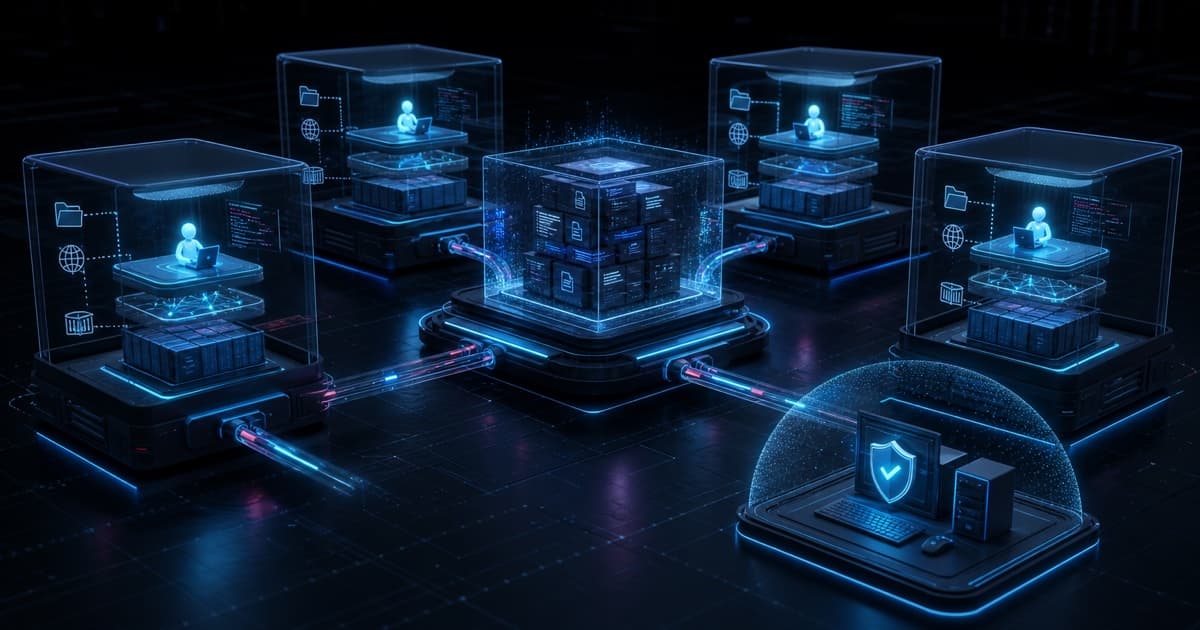
Docker Sandboxes matter because AI agents no longer only suggest code. They run commands, install packages, run tests, edit files, and reach the network. When the agent becomes a shell operator, the environment must become a security boundary. The question stops being "is the model good?" and becomes: where can this model act without damaging my host, secrets, or repository?
Docker's product targets that exact point: running coding agents in microVM sandboxes, with a separate Docker daemon, filesystem, and network. This does not remove human review, access policy, or tests. But it raises the minimum bar for using agents with real autonomy.
Why do sandboxes matter now?
Because the agentic era expanded the blast radius of software you do not fully control.
Old autocomplete suggested one line. Old chat generated a snippet. A modern coding agent can do this:
- Clone or open a repo.
- Read sensitive files by accident.
- Install dependencies.
- Execute postinstall scripts.
- Start local services.
- Call external APIs.
- Run Docker.
- Create commits.
- Open a PR.
That is powerful. It is also a larger risk surface. Prompt injection, malicious packages, destructive commands, token leakage, and unsafe Docker socket access stop being theory when the agent has shell and network access.
The mature answer is not to turn agents off. It is to put agents inside disposable, auditable environments with explicit permissions.
What is Docker Sandboxes?
Docker Sandboxes is Docker's answer for running coding agents in isolated environments. The docs say each sandbox gets its own Docker daemon, filesystem, and network, so the agent can build containers, install packages, and modify files without touching the host system directly.
In practice, the product combines four ideas:
| Idea | Why it matters |
|---|---|
| MicroVM per sandbox | The agent runs behind a stronger boundary than a normal local process. |
| Isolated Docker daemon | The agent can use docker build and docker compose without access to the host Docker daemon. |
| Controlled filesystem | The agent sees the allowed workspace, not the whole machine. |
| Network and credentials by policy | External access and secrets become configuration, not implicit trust. |
The last point matters most for teams. The problem is not only "my agent can break my machine". The problem is: every person on the team may be running agents with different permissions. Docker is trying to turn sandboxing into organization policy, with network, filesystem, and MCP rules applied centrally.
Why is Docker different?
Docker did not invent sandboxing. Its advantage is distribution, DX, and governance in a place where many developers already use Docker.
The common path today is improvised: a devcontainer, a worktree, a local VM, a CI runner, a container with a bind mount, or a cloud sandbox service. That works until the agent needs more autonomy, more parallelism, or more access to system tools.
Docker Sandboxes tries to become the local default for this new workflow:
- The agent runs close to the repository.
- The agent can use Docker inside the sandbox.
- The host does not need to expose its Docker socket.
- The workspace can be mounted or cloned based on risk.
- The organization can define access policy.
My read is simple: sandbox is the new dev environment for agents. The old dev environment optimized human onboarding. The agentic sandbox optimizes autonomy with limits.
Who competes with Docker Sandboxes?
There are competitors, but they compete at different layers.
| Alternative | Layer | Best use | Watch out |
|---|---|---|---|
| Dev Containers | Development environment | Standardize project toolchain, extensions, and runtime | It is not, by itself, a complete boundary for untrusted agents. |
| Sandcastle | Coding agent orchestration | Run agents across branches, worktrees, and sandboxes with commits as output | It coordinates the flow. Isolation depends on the chosen provider. |
| E2B | Cloud sandbox for agents | Execute code in remote environments with real-world tools | Strong for product and cloud scale, less natural for local Docker-first workflows. |
| Daytona | Sandbox infrastructure for agents | Fast, stateful sandboxes with SDKs and isolation for AI-generated code | The choice depends on persistence, cost, region, and configured isolation model. |
| Vercel Sandbox | Ephemeral cloud VM | Run untrusted code in apps, agents, and user uploads | Great for product work on Vercel, not always a replacement for local development. |
| Cloudflare Sandboxes | Persistent containers at the edge | Agents with filesystem, shell, background processes, and preview URLs in Workers | Strong for Cloudflare apps, with a different operating model. |
| Modal Sandboxes | Cloud compute at scale | High concurrency, AI workloads, RL, and massive sandbox fleets | More production infrastructure than local coding agent environment. |
| CodeSandbox SDK | Programmable cloud environments | Code execution, previews, and agents inside a product | Best when browser IDE or cloud sandboxing is part of the product. |
The point is not to pick a universal winner. It is to pick the right layer.
Is devcontainer a competitor or a complement?
Devcontainer is more complement than direct competitor.
A devcontainer.json describes a repeatable development environment: image, extensions, features, ports, commands, and dependencies. That is excellent for humans and agents starting from the same toolchain.
But a regular devcontainer does not answer these questions by itself:
- Can the agent access the host Docker daemon?
- Can the agent read files outside the workspace?
- Is external network access allowed by default?
- Where do tokens live?
- What happens if a package installs something malicious?
- How does the company enforce the same rule on every machine?
So the practical read is simple: use devcontainer for reproducibility. Use Docker Sandboxes, microVMs, or cloud sandboxes for execution isolation.
Is Daytona a direct competitor?
Daytona is a more direct competitor than Sandcastle when the question is agent infrastructure.
The product positions itself as secure and elastic infrastructure for running AI-generated code and agent workflows. The main difference is focus: Daytona wants to be the programmable layer for fast, stateful sandboxes driven by SDKs. That fits when you are building an agent platform, a product that executes user code, or a system that needs to create environments on demand.
Compared with Docker Sandboxes, I would read it like this:
| Question | Docker Sandboxes | Daytona |
|---|---|---|
| Where does it start best? | Laptop, workstation, local coding agent workflow | Product, platform, programmable sandbox via SDK |
| What does it emphasize? | Local microVM, isolated Docker daemon, policies, and governance | Fast sandbox creation, state, SDK, and elastic infrastructure |
| When does it win? | The agent needs to work in a real repo with Docker without touching the host | The agent needs a managed, scalable, API-accessible environment |
If a company is buying sandbox infrastructure for an agentic product, Daytona belongs early in the list. If the problem is protecting the developer laptop while Claude Code or Codex works in the repo, Docker Sandboxes feels more natural.
Is Vercel Sandbox a direct competitor?
Vercel Sandbox also deserves first-class competitor treatment, especially for web products and SaaS platforms.
The pitch is to run untrusted code in isolated, ephemeral VMs. That fits agents that generate apps, evaluate code, process user uploads, execute scripts, or need a clean remote environment per task.
Compared with Docker Sandboxes:
| Question | Docker Sandboxes | Vercel Sandbox |
|---|---|---|
| Where does it start best? | Local workflow with coding agents and Docker | Cloud product, Vercel app, user code, or remote agent |
| What does it emphasize? | Local safety, internal Docker, network and filesystem policy | Ephemeral VM execution, Vercel stack integration, and web apps |
| When does it win? | I want to isolate agents in the development environment | I want to execute untrusted code inside a product |
If your product already lives on Vercel and needs to execute agent or user code, Vercel Sandbox may be the more direct choice. If the goal is giving agents autonomy in a local repo, Docker Sandboxes stays closer to the engineer's workflow.
Is Sandcastle a competitor or a higher layer?
Sandcastle is a higher layer.
It is a TypeScript library for orchestrating coding agents in sandboxes. Its value is the engineering workflow: run an agent, choose a branch strategy, capture commits, manage worktrees, and bring the result back for review.
Docker Sandboxes answers a different question: where does the agent run safely?
These two can coexist:
| Question | Natural tool |
|---|---|
| How do I create branches, sessions, commits, and merge back? | Sandcastle |
| How do I isolate the agent, Docker daemon, network, and filesystem? | Docker Sandboxes |
If you are building issue-to-PR automation, Sandcastle can coordinate. But it should not get the same weight as Daytona or Vercel Sandbox as an infrastructure vendor. Sandcastle is closer to a workflow orchestrator. Daytona, Vercel Sandbox, E2B, Cloudflare, Modal, and CodeSandbox compete more directly at the execution layer.
When should you use each alternative?
My practical rule:
| Situation | Likely choice |
|---|---|
| I want to run Claude Code, Codex, or another local agent with stronger isolation | Docker Sandboxes |
| I want to standardize the project environment for humans and agents | Dev Containers |
| I want a local or CI pipeline that creates commits on separate branches | Sandcastle |
| I want programmable sandbox infrastructure for agent products | Daytona |
| I want to run untrusted code inside a web product on the Vercel stack | Vercel Sandbox |
| I want to execute user or agent code inside a SaaS product | Vercel Sandbox, Cloudflare Sandboxes, E2B, Daytona, or CodeSandbox SDK |
| I want thousands of sandboxes and elastic compute for AI workloads | Modal |
| I want centralized network, filesystem, and MCP policy on team laptops | Docker Sandboxes with governance |
The signal that would make me choose Docker first: the agent needs to work in a real repo, locally or near the developer's laptop, with Docker tooling, without privileged access to the host.
The signal that would make me choose Daytona or Vercel first: the agent is part of a multi-tenant product, receives user code, needs to scale on demand, or needs managed preview URLs for customers.
How do you use Docker Sandboxes?
On macOS, the starting path is:
brew trust docker/tap
brew install docker/tap/sbx
sbx login
Then enter a project and run an agent:
cd ~/my-project
sbx run claude
Or with Codex:
cd ~/my-project
sbx run codex
The basic lifecycle is:
sbx run claude        # start an agent
sbx ls                # list running sandboxes
sbx stop my-sandbox   # pause the sandbox
sbx rm my-sandbox     # remove the sandbox
For a safer posture, I would start with four habits:
- Use clone mode when you want changes and branches to stay inside the sandbox before bringing anything back to the host.
- Run
sbx policy lsto understand active network and filesystem rules. - Run
sbx policy logto see which hosts the sandbox tried to reach. - Configure secrets with
sbx secret, not by pasting tokens into the agent environment.
A careful local workflow would look like this:
cd ~/my-project
sbx run --clone codex
sbx policy log
git fetch sandbox-<sandbox-name>
git diff main..sandbox-<sandbox-name>/<branch>
The important detail: the sandbox reduces operational risk, but it does not remove review. You still need to inspect the diff, tests, dependencies, scripts, and merge scope.
What should you check before adopting?
I would check five criteria:
| Criteria | Question |
|---|---|
| Isolation | Is the boundary a container, microVM, VM, isolate, or something else? |
| Docker | Does the agent need real Docker, Docker Compose, or image builds? |
| Network | Is internet egress open, audited, or denied by default? |
| Credentials | Does the secret enter the sandbox, or stay on the host behind a proxy? |
| Persistence | Is the environment ephemeral, stateful, snapshotted, or cloned? |
For coding agents, I would give extra weight to isolated Docker daemon and network policy. Many modern projects depend on docker compose for databases, queues, cache, and local services. Giving the host Docker socket to an agent is too much permission.
Which sources are worth reading?
These are the main sources I checked on August 11, 2026:
- Docker Sandboxes
- Docker Sandboxes docs
- Docker Sandboxes isolation layers
- Docker Sandboxes usage
- Dev Containers specification
- Sandcastle on GitHub
- E2B
- Daytona
- Vercel Sandbox
- Cloudflare Sandbox docs
- Modal Sandboxes
- CodeSandbox
What is the summary?
TL;DR: Docker Sandboxes matters because agents now execute real work. When an agent can run commands, install packages, use Docker, and reach the network, it needs an execution boundary.
Devcontainers solve reproducibility. Sandcastle solves coding agent orchestration. Daytona and Vercel Sandbox are more direct infrastructure competitors, especially for agentic products and cloud execution. E2B, Cloudflare, Modal, and CodeSandbox also compete at that layer. Docker Sandboxes is most interesting when you want stronger isolation in the local agent workflow, with a separate Docker daemon, microVM, network policy, and governance.
In the agentic era, sandboxing is not a security detail. It is part of the product.
Written by AI, reviewed by Thiago Marinho
August 12, 2026 · Brazil