From feudalism to AI: how to read past revolutions
AI revolution: understand how feudalism, empires, and industry changed scarcity, power, and work so you can decide better now.
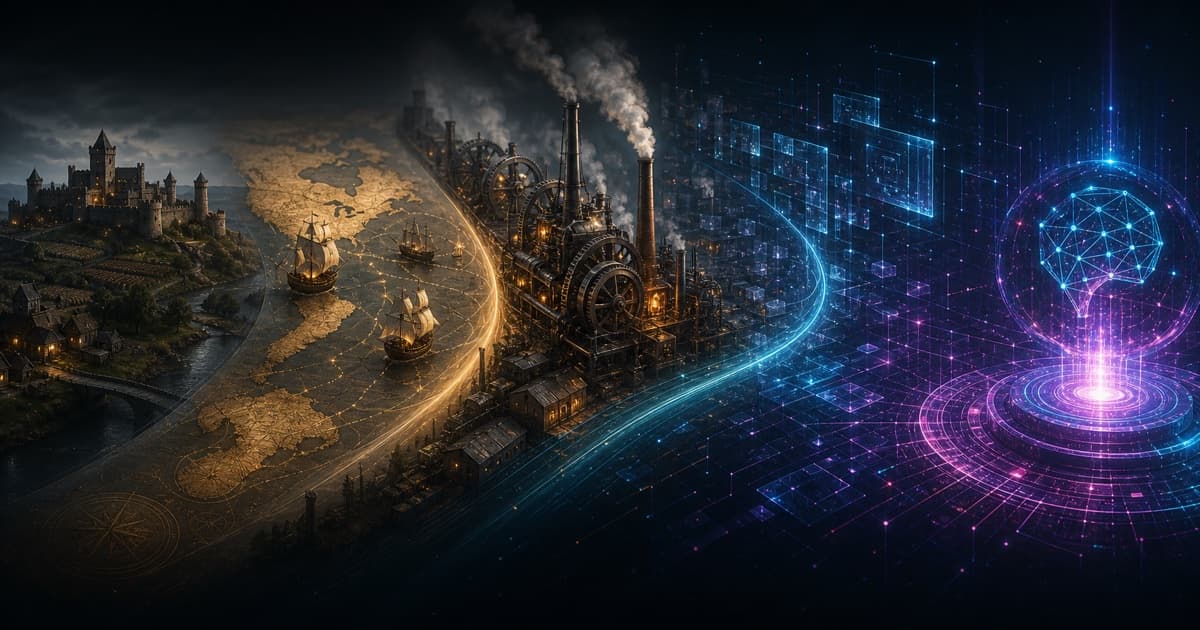
The AI revolution is easier to understand when we look at past revolutions by what they really changed: scarcity, power, work, and organization. Feudalism, empires, the industrial revolution, and the digital age were not only tool changes. Each phase changed the scarce resource, reorganized who had power, and exposed people who kept playing by old rules.
The goal is not to predict the future like a prophecy. It is to reduce surprise. When you understand how a revolution changes the board, you can mitigate the present impact and anticipate where the next advantage may appear.
How do games like Age of Empires help us think about history?
Age of Empires and Age of Mythology work as useful metaphors because they show a simple idea: when the age changes, the old strategy loses strength.
At the start, you collect food, wood, gold, and stone. Then you need to research technologies, train different units, expand territory, defend routes, improve the economy, and choose when to advance to the next age. You do not win the Imperial Age with a Feudal Age strategy.
Real life is more complex, but the pattern repeats:
| In the game | In history |
|---|---|
| Scarce resource changes | Land, energy, capital, information, and cognition change value |
| Technology unlocks a new age | Navigation, steam power, electricity, the internet, and AI change capability |
| Dominant unit changes | Knight, ship, factory, platform, and agent change the center of force |
| Old strategy loses efficiency | Institutions, companies, and careers need to reorganize |
The mistake is to think a revolution only adds a tool. It changes the rules of advantage.
What does feudalism teach us about scarcity?
Under feudalism, the central resource was protected land. Agricultural production, local security, and political loyalty organized life. Power stayed close to territory, the castle, military protection, and control over who could produce.
The common worker had little mobility. The feudal lord had power because he controlled access to land and protection. The church, nobles, and vassal relationships gave meaning, order, and legitimacy to the system.
The lesson is not to romanticize or simplify the Middle Ages. The lesson is to see the pattern:
| Dimension | Feudal logic |
|---|---|
| Scarcity | Productive land and protection |
| Power | Local control and personal obligation |
| Work | Farming and servitude |
| Mobility | Low |
| Risk | War, famine, disease, and local instability |
When scarcity is land, the person who controls territory controls the game. When scarcity changes, that power starts to lose its exclusive position.
How did empires change the board?
Empires expanded the game. The center was no longer only the local fief. It started to include sea routes, global trade, colonies, bureaucracy, professional armies, taxes, cartography, navigation, and resource extraction.
In Age of Empires terms, it is like moving from local defense into an open map. Advantage moves to whoever controls navigation, logistics, trade, gunpowder, alliances, and administration.
This phase reorganized power at scale:
| Before | After |
|---|---|
| Power tied to local territory | Power tied to routes, trade, and colonies |
| Defense as castle | Defense as navy, army, and bureaucracy |
| Local production | Global extraction and exchange |
| Personal authority | State, empire, and administration |
The important point is that empires did not win only because they had more soldiers. They won because they connected territory, technology, information, and logistics.
That also had a cost. Empires created wealth for some and violence for many. Colonization, slavery, exploitation, and cultural erasure were part of the process. Every revolution increases capability, but capability without moral limits also increases harm.
What changed after empires?
The post-imperial world did not end concentrated power. It changed the shape of power. Nation-states, global companies, financial institutions, international agreements, supply chains, and media started to compete for influence.
Formal empire lost space, but dependency continued through other means:
| Classical empire | Post-imperial order |
|---|---|
| Formal colony | Economic and technological dependency |
| Army occupying territory | Market, debt, software, infrastructure, and standards |
| Map drawn by empires | Global chains drawn by capital and logistics |
| Explicit domination | Less visible operational dependency |
This matters for understanding AI. The next form of dependency may not be a flag on a territory. It may be a model, a cloud, an app store, a distribution platform, a dataset, a chip, an API, or an agent controlling part of the workflow.
Modern power tends to become more abstract. That also makes it harder to see.
What did the industrial revolution really change?
The industrial revolution changed the source of force. Before it, production depended heavily on human muscle, animal power, water, wind, and craft skill. After it, machines, coal, steam, electricity, factories, and capital multiplied production.
Work did not disappear. It was reorganized. The workshop became the factory. The artisan became the worker. The time of nature lost space to clock time. Cities grew. The modern company became more important.
| Dimension | Before industry | After industry |
|---|---|---|
| Energy | Human, animal, water, and wind | Coal, steam, electricity, and oil |
| Production | Craft and local | Mechanized and scaled |
| Work | Trade skill and agriculture | Operation, production line, and specialization |
| Organization | Workshop, field, and local commerce | Factory, railway, city, and corporation |
| Advantage | Manual skill and local control | Capital, machine, energy, and process |
This revolution also created pain. Professions lost value. Cities became overcrowded. Workdays were brutal. Labor laws, unions, technical education, and public infrastructure came later, often too late.
The lesson is direct: productivity arrives before social protection. First, the system learns to extract value. Then society fights to limit harm.
How did the digital age prepare the AI revolution?
The digital age changed scarcity again. Computers, the internet, software, smartphones, cloud, and platforms reduced the cost of copying, distributing, and coordinating information.
Before the internet, distribution was expensive. After it, one person or a small company could publish, sell, support, teach, create software, and reach the whole world. The bottleneck was no longer only production. It became being found, being trusted, and holding attention.
| Industrial age | Digital age |
|---|---|
| Machine multiplies physical force | Software multiplies information |
| Factory centralizes production | Platform centralizes distribution |
| Capital buys machine | Network, data, and product create scale |
| Worker operates process | Professional operates systems and information |
The digital age also prepared AI because it created data, infrastructure, chips, cloud, APIs, connected products, and automation habits. AI did not appear from nowhere. It grew on top of decades of digitalization.
What does the AI revolution change now?
Artificial intelligence changes the scarcity of cognitive execution. Writing, summarizing, classifying, translating, generating code, designing interfaces, researching, creating images, analyzing documents, and automating workflows became cheaper.
This does not mean human thought ended. It means part of mental work became an abundant tool.
| Before generative AI | With generative AI |
|---|---|
| Text was a bottleneck | Text becomes a cheap draft |
| Code required more manual execution | Code can be generated, tested, and reviewed by agents |
| Initial design was more expensive | Prototypes appear in hours |
| Research required more human time | First synthesis becomes faster |
| Specialist depended on technical team | Specialist can prototype alone |
The new bottleneck moves elsewhere: judgment, context, trust, distribution, proprietary data, responsibility, and the ability to integrate everything into a reliable system.
That is the difference between using AI and gaining advantage with AI. Using the tool is easy. Turning the tool into a reliable process is hard.
How can we mitigate the present revolution?
Mitigating the present revolution means treating AI as a system change, not as a tool trend.
For a person, this means:
- Learn to use AI in real work, not only in demos.
- Strengthen fundamentals that AI does not replace well: judgment, domain knowledge, writing, architecture, negotiation, and responsibility.
- Turn repeated tasks into prompts, scripts, agents, checklists, or processes.
- Separate prototype from reliable product.
- Measure quality, not only speed.
For a company, this means:
- Map where AI reduces cost without destroying quality.
- Define which data can enter models and which data cannot.
- Create human review for sensitive decisions.
- Measure error, rework, risk, and user satisfaction.
- Avoid firing first and understanding later.
- Convert lessons into process, training, and governance.
The good question is not "how do we replace people with AI?". The good question is: where does AI reduce waste without removing critical judgment?
How can we anticipate the next revolution?
Anticipating the next revolution is not about predicting the exact technology. It is about watching which scarcity is changing.
Use this practical model:
| Question | Why it matters |
|---|---|
| What became cheap all at once? | A cheap task stops being an advantage |
| What became more expensive or rare? | The new bottleneck becomes a center of power |
| Who gained leverage? | Small actors can compete with large structures |
| Who lost protection? | Old careers, companies, and institutions become exposed |
| What new dependency appeared? | Power can move to platforms, data, chips, energy, or regulation |
| What harm grew with the new capability? | Every revolution needs limits |
In AI, some clues are already visible. Cognitive execution became cheap. Trust became more valuable. Proprietary data became more important. Distribution remains decisive. Energy, chips, and infrastructure moved back to the center. Regulation and reputation may separate serious companies from theater.
The future may belong less to those who "use AI" and more to those who can orchestrate people, agents, data, processes, and trust.
What is the summary?
Technological revolutions do not only change tools. They change dominant scarcity, the shape of power, the type of work, and the winning organization.
Feudalism put land and protection at the center. Empires scaled routes, logistics, and extraction. The industrial revolution multiplied physical force with energy and machines. The digital age multiplied information. AI now multiplies cognitive execution.
To mitigate the present revolution, learning a tool is not enough. We need to protect judgment, context, data, trust, and responsibility. To anticipate the next one, watch what became cheap, what became scarce, and who started to control the new bottleneck.
Written by AI, reviewed by Thiago Marinho
July 4, 2026 · Brazil