Products were automation before software
Automation before software: understand how products, services, and technology packaged processes long before AI.
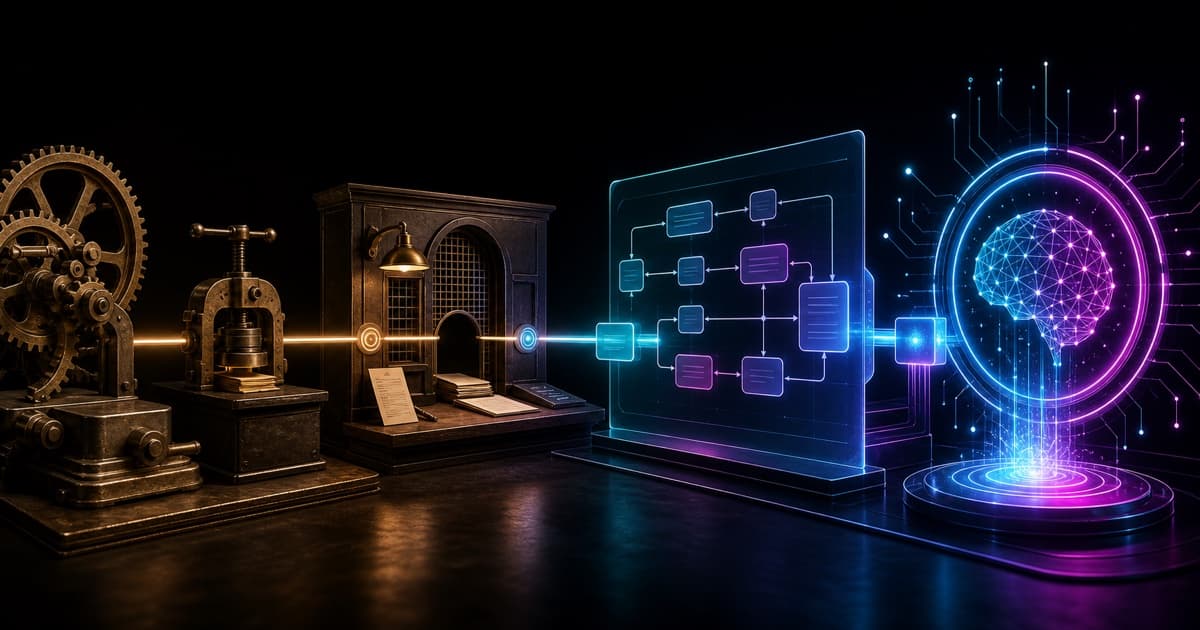
Automation before software already existed in products, services, and technologies that turned repeated work into reliable process. Software did not invent automation. It made automation programmable, copyable, measurable, and distributable at scale.
This lens helps explain the AI revolution. Artificial intelligence is not appearing outside history. It is another step in an old sequence: take a human intention, embed part of it in a tool, reduce friction, and move the bottleneck somewhere else.
How did products automate before software?
A product has always been packaged automation. It takes a repeated need and turns it into an object, machine, method, or system that reduces future effort.
A wheel automates part of transport. A mill automates part of grinding. A clock automates time measurement. A printing press automates text reproduction. An assembly line automates sequence, rhythm, and division of work.
Before software existed, products already did three things we now associate with digital systems:
| Function | Example before software |
|---|---|
| Reduce effort | Lever, pulley, wheel, and motor |
| Standardize output | Mold, press, interchangeable part, and recipe |
| Transfer knowledge | Manual, jig, specialized tool, and machine |
The product carries a design decision. When someone uses scissors, a screwdriver, or a sewing machine, they are not only using matter. They are using someone else's knowledge embedded in physical form.
How did services automate without looking like automation?
A service automates experience through human process. It organizes steps, roles, scripts, queues, rules, training, and expectations to deliver a repeatable result.
A bank before the app already had forms, tickets, counters, checks, signatures, stamps, and ledgers. A restaurant already had a menu, kitchen prep, service flow, order sequence, and checkout. A hotel already had reservation, check-in, cleaning, keys, billing, and protocol.
This is automation without code:
| Service | Embedded automation |
|---|---|
| Bank | Form, validation, signature, record, and clearing |
| Restaurant | Menu, order ticket, kitchen, table flow, and payment |
| Postal service | Address, sorting, route, delivery, and manual tracking |
| Hospital | Intake, triage, medical record, protocol, and shift schedule |
| School | Curriculum, class, exam, grade, and progression |
The service turns uncertainty into a path. Even when people execute each step, there is automation in the design of the process.
How did technology become automation of capability?
Technology embeds capability in a tool. It takes something that used to depend on human force, memory, skill, or presence and turns it into a more repeatable way to execute the same function.
Agriculture automated part of survival. Writing automated memory. Accounting automated control. Navigation automated orientation. Printing automated copying. The factory automated production. Electricity automated distributed force.
Every important technology does at least one of these things:
- Reduces dependence on human force.
- Reduces dependence on human memory.
- Reduces dependence on human presence.
- Reduces variation between executions.
- Increases scale without increasing effort at the same rate.
That is why technology changes power. Whoever controls the technology that reduces the bottleneck gains margin, speed, reach, or coordination.
What did software add to this story?
Software made automation more abstract. Instead of automating only with physical form, machine, or human process, it automates rules, states, calculations, flows, permissions, communication, and operational decisions.
Software took old automations and put them inside digital systems:
| Before | With software |
|---|---|
| Paper form | Online form with validation |
| Ledger | Database and dashboard |
| Physical line | Queue, ticket, and status |
| Operations manual | Guided workflow |
| Front-desk calendar | Shared calendar |
| Printed catalog | Search, filter, and recommendation |
The big change was malleability. A physical machine can automate one task well, but changing its behavior may require parts, factories, and distribution. Software changes with code, deployment, and configuration.
That does not make software magic. It only makes automation easier to change, copy, and distribute.
Why is software also product and service?
Software as product delivers a ready capability: editor, spreadsheet, sales system, digital bank, delivery app, operating system, design tool, or support platform.
Software as service delivers continuous process: hosting, updates, support, data, security, integration, billing, and availability. The user does not buy only code. The user buys the system working.
This mix explains why software companies scaled so much. They joined three layers:
| Layer | What it automates |
|---|---|
| Product | A capability the user can trigger |
| Service | The operation that keeps the capability available |
| Platform | Distribution and integration with other systems |
The best software is not only a good-looking screen. It is business automation with interface, data, rules, trust, and support.
How does AI change products and services?
Artificial intelligence changes the kind of automation that is possible. Traditional software automates explicit rules. AI automates part of interpretation, generation, classification, synthesis, and adaptation.
This changes products:
| Product without AI | Product with AI |
|---|---|
| User fills fields | System understands intent in natural language |
| Keyword search | Meaning-based search |
| Fixed report | Analysis generated for the context |
| Interface full of steps | Agent executes part of the flow |
| Decision-tree support | Contextual support answer |
It also changes services:
| Traditional service | Service with AI |
|---|---|
| Support follows a script | Support interprets case and history |
| Consulting delivers a document | Consulting delivers a living system |
| Operation depends on a large team | Operation combines team, agents, and review |
| Training is an event | Training becomes a copilot inside the workflow |
The point is not that AI replaces everything. The point is that it moves automation into tasks that used to depend more on language, context, and first judgment.
Where is the risk in this new automation?
The risk of AI automation is confusing execution with responsibility. A system can write, answer, classify, recommend, and trigger tasks. That does not mean it understood the human, legal, financial, or operational impact of each decision.
Every automation carries assumptions. An assembly line assumes the right sequence. A form assumes which data matters. An algorithm assumes a rule. An AI agent assumes context, goal, limit, and quality criteria.
The main risks are clear:
- Automating a bad process and scaling the error.
- Removing people who protected invisible quality.
- Measuring speed and ignoring rework.
- Trusting fluent answers without validation.
- Creating dependency on platforms, models, or data the company does not control.
- Thinking that a good prompt can replace domain knowledge, review, and responsibility.
Good automation reduces waste. Bad automation industrializes confusion.
How should we think about AI products with more maturity?
A mature AI product does not start with "where do we put AI?". It starts with "which part of the process needs to become cheaper, faster, more accurate, or more accessible?".
Use this filter:
| Question | Decision it forces |
|---|---|
| What repeated work exists here? | Defines the automation target |
| Which judgment must stay human? | Defines the AI boundary |
| Which data supports the answer? | Defines trust and governance |
| How does error appear? | Defines observability |
| Who reviews sensitive decisions? | Defines responsibility |
| What improves for the user? | Defines real value |
If AI does not reduce real friction, improve quality, or make the service more reliable, it is decoration. It may sell in the short term, but it does not sustain a product.
What is the summary?
Products, services, and technology automated work before software. A product packages capability. A service packages process. A technology packages leverage. Software made all of that programmable, copyable, and distributable.
AI continues this story. It automates part of cognitive execution and changes what can become a product or service. The advantage is not saying that you use AI. It is knowing which bottleneck was removed, which new bottleneck appeared, and which judgment must remain human.
Written by AI, reviewed by Thiago Marinho
July 5, 2026 · Brazil