PRD vs SPEC: which one to write first (and why with AI it matters more)
The practical difference between a Product Requirements Document and a Technical Specification, the natural flow between them, and why skipping the PRD in the AI era is the fastest path to shipping the wrong thing.
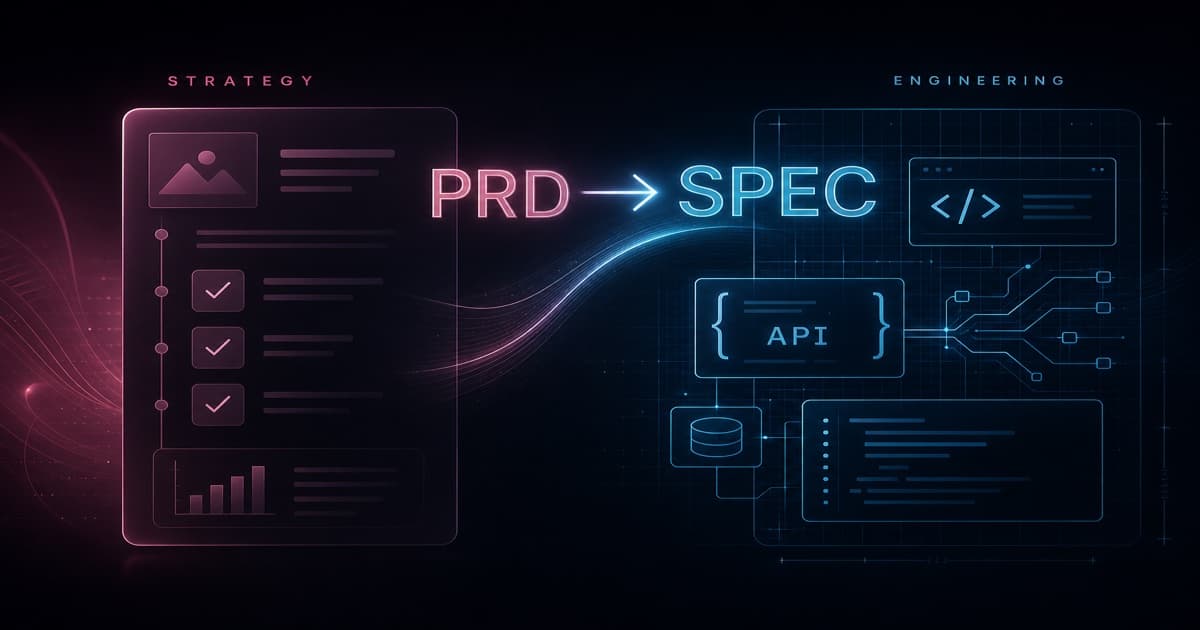
Every time someone sends me a prompt like "write the SPEC for this feature", I pause and ask the same thing: where is the PRD?
It is not process purism. With AI in the loop, the order of these documents matters more, not less.
What each one is
PRD (Product Requirements Document) answers what and why:
- What problem are we solving
- For whom (personas, audience)
- Why now (business context, metrics)
- High-level functional requirements
- Success criteria and what is explicitly out of scope
It is a strategic document, typically authored by the Product Manager, meant to align business, design, engineering, and marketing.
SPEC (Technical Specification) answers how:
- Proposed architecture
- Technologies, libraries, patterns
- Data modeling, schemas, API contracts
- Detailed flows, edge cases, error handling
- Technical trade-offs and alternatives considered
- Rollout, migration, observability
It is a technical document, typically authored by a Tech Lead or engineers.
Quick comparison
| Aspect | PRD | SPEC |
|---|---|---|
| Core question | What / Why | How |
| Typical author | Product Manager | Engineer / Tech Lead |
| Audience | Cross-functional teams | Engineering |
| Language | Business + product | Technical |
| Comes first | Yes | After the PRD |
The natural flow
PRD → conversation with engineering → SPEC → implementation.
On small teams or simple features, both collapse into a single document (sometimes called an RFC or design doc). On larger products, or regulated contexts, splitting them keeps responsibility clear.
Why with AI the PRD matters more, not less
AI is great at producing volume of code, fast. That is the trap: you ship the wrong thing quickly and find out late.
When you ask for a SPEC with no PRD, the AI quietly fills the gaps for you. The code comes out clean, coherent, runnable — solving a problem that is not exactly yours.
The PRD forces you to make explicit:
- The actual problem
- The business rules
- The acceptance criteria
- What is out of scope
Without that, the AI silently makes decisions that should be yours.
A concrete example
I recently got a prompt that went roughly like this:
"I want a feature for legally valid digital terms under Brazilian law, similar to what Autentique does. The person signs, takes a selfie, uploads their document. The organizer can approve, reject, or send it back. The system receives the term as rich text and renders a cover with the participant's name, tax ID, and email."
It reads descriptive, but several decisions are hidden in there:
- Legal validity. Brazilian MP 2.200-2/2001? Law 14.063/2020? Simple, advanced, or qualified electronic signature? Each one requires different architecture.
- Build vs integrate. Use Autentique's API or reimplement? Changes 100% of the SPEC.
- MVP scope. Is selfie + document enough? Or do you need geolocation, timestamps, hashing, audit trails?
- Privacy law. Where are documents stored? For how long? Who has access?
- Term versioning. If the term changes, what happens to previous signatures? Legally relevant.
Asking the AI for a SPEC directly with this input gets you confident code solving the wrong problem.
A workflow that works
1. Brain dump → PRD (with AI, but making the AI ask first)
The trick is to not ask for the PRD directly. Ask this instead:
"I'll describe a feature. Before writing the PRD, ask me the questions needed to eliminate ambiguity around scope, business rules, and acceptance criteria. After I answer, write the PRD."
This flips the game. The AI starts asking exactly the things you have not thought through.
2. PRD → SPEC (in a fresh context)
With the PRD ready, open a new conversation, paste the PRD, and ask for the SPEC. Now the AI has enough context to propose coherent architecture.
3. SPEC → implementation
Then code — ideally broken into smaller tasks, each one traceable back to an acceptance criterion in the PRD.
When you can skip the PRD
For small, well-defined work — "add a CSV export button to this table" — skipping the PRD is fine. Go straight to a SPEC or just to code.
My rule of thumb: if the feature has more than one actor, external integration, or legal/financial/regulatory implications, write the PRD. Every time.
Closing
PRD and SPEC are not bureaucracy. They are the way you make explicit what would otherwise become an implicit decision by whoever implements it — human or AI.
With AI in the loop, the cost doubles: because it executes fast, getting the definition wrong is expensive in rework. The PRD does not slow you down. It keeps you from accelerating in the wrong direction.
Written by AI, reviewed by Thiago Marinho
May 14, 2026 · Brazil