Where Java with Spring Boot still beats Node.js (and where it doesn't)
It is not Java vs Node in the abstract. It is about where the maturity of the Spring ecosystem solves the boring production problems out of the box, the ones Node still puts together piece by piece, and where Node + TypeScript stay the obvious call. With honesty about Virtual Threads, types that vanish at runtime, and what really decides: the requirement.
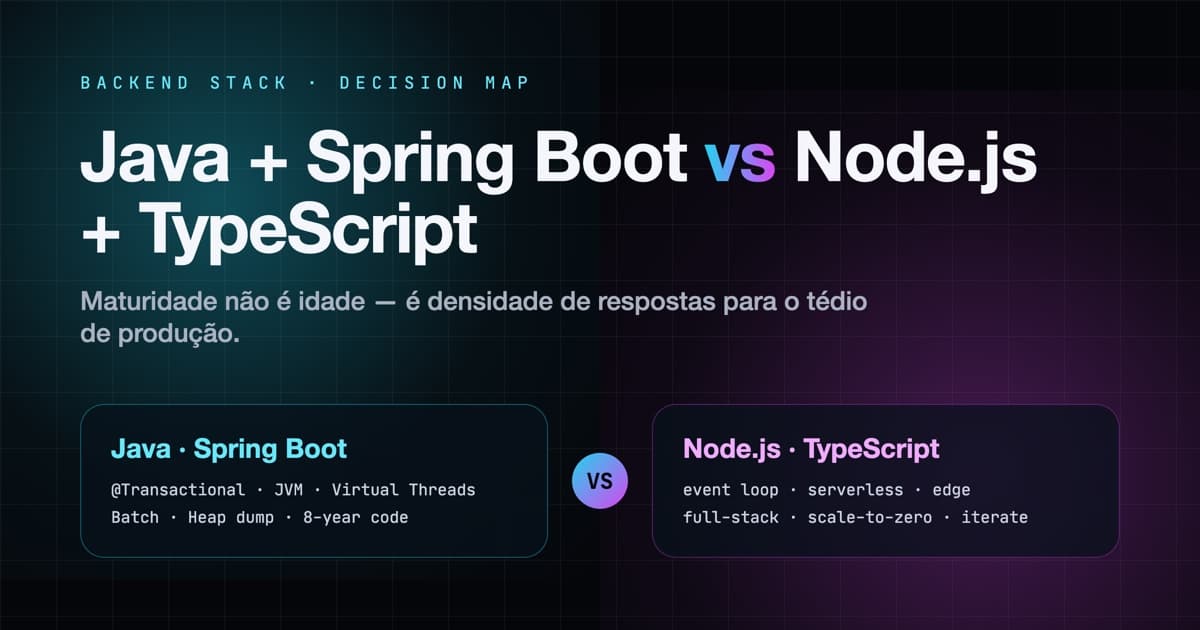
Every "Java vs Node" thread turns into the same sports fight. One side mocks verbosity and AbstractFactoryBean. The other mocks callback hell and a node_modules folder as heavy as a black hole. It is entertainment, not engineering.
The real question is different: where does the maturity of Java + Spring Boot solve a problem that Node + TypeScript still solve piece by piece? And the other way around: where does that same maturity become dead weight, so Node wins clean?
I will try to answer that without picking a side, the way I would actually choose a stack on a real project.
Maturity is not age. It is the density of answers to the boring stuff.
"Java is more mature because it is older" is a lazy take. COBOL is older still. Ecosystem maturity is not measured in years. It is measured in how many boring production problems already have a standard, battle-tested answer, used by thousands of companies, right out of the box.
The boring problems are always the same: distributed transactions, retry with backoff, connection pooling, pagination, method-level authorization, batch jobs over millions of rows, observability, schema migration, connection draining on deploy. None of it is glamorous. All of it breaks production at 3 a.m.
So the right axis is simple: when you hit that problem, does the ecosystem hand you a ready, battle-tested answer, or three libraries from one maintainer and a blog post from 2019?
Where Java + Spring Boot is the more valid choice
1. Heavy transactional domains (banking, insurance, ERP, logistics).
Spring was born in the enterprise world, and here that is an advantage, not a stigma. You get declarative transactions with @Transactional, transaction propagation across layers, JTA for real distributed transactions, Spring Data for repositories without boilerplate, and Spring Batch to process millions of records with checkpoint and restart. In Node you build that from Prisma, plus a queue library, plus a retry library, plus glue you write by hand. And each piece comes from a different maintainer.
2. Large teams on long-lived monoliths. You get real strong typing, enforced by the JVM at runtime, plus IDE refactoring that moves 400 files without fear, plus a compiler that complains before the deploy. In code that will live 8 years and pass through 30 developers, that rigor is a feature, not red tape. TypeScript gives you a lot of this while you write the code. But, as we will see, it disappears at runtime.
3. CPU-bound work and real parallelism.
Heavy processing, math, data transformation, an algorithm that maxes out a core: the JVM has real multithreading, with shared memory and a garbage collector tuned for 25 years. Node's single-thread plus event-loop model was built for I/O, not for burning CPU. A heavy CPU job blocks the loop, and you end up juggling worker_threads or a cluster of processes.
4. Operations and production debugging.
Here the gap is huge. Java Flight Recorder, heap dumps, thread dumps, production profiling with almost no overhead, an observable GC, JMX. When a Java service leaks memory, you take a heap dump and see the object to blame. When a Node service leaks memory, you pray, attach --inspect, and compare heap snapshots hoping to reproduce it. Decades of production tooling do not appear in one hype cycle.
5. A tight enterprise ecosystem with serious maintainers. Spring Security for authz and authn (OAuth2, SAML, method security); Spring Cloud for service discovery, central config, circuit breakers; mature JDBC drivers for every database out there; Micrometer for metrics. It is a curated ecosystem, versioned together, kept by a foundation (now VMware/Broadcom) with a predictable release train. It is not a patchwork of npm packages in different states of neglect.
6. Long-term stability of the contract.
The JVM treats backward compatibility almost like a religion. Code from 2010 still runs. In the Node world, a new framework major every 18 months, plus the node_modules wheel of fortune, charges a maintenance tax that is not small in a long-lived product.
Where Node + TypeScript still win clean
It would be unfair to stop here. It is just as unfair to pretend Node does not have its own ground, where Java becomes the wrong weight.
1. I/O-bound work with thousands of light connections. BFF, API gateway, proxy, realtime (WebSocket, SSE), a service that spends all day waiting on the network and the database. The event loop was built for exactly this. It gives you very high throughput with a small memory footprint. Here Node's model is an architecture win, not a limit.
2. Full-stack in one language. Front and back in TypeScript, types shared from end to end, one team, one mental model. For a web product, above all with Next.js, tRPC, and server actions, this is a speed lever the Java-on-the-back, TS-on-the-front split does not have.
3. Serverless, edge, and cold starts. Short-lived functions, edge runtime, scale to zero. The JVM cold start has long been rough here. GraalVM native image helps, but it brings its own build cost and traps. Node boots in milliseconds and is the natural default of the serverless world.
4. Speed of iteration and prototyping. A startup testing an idea, an MVP, a product that changes shape every week: Node's loop is shorter, the frontend ecosystem is native, and there is less ceremony. Spring's maturity is an asset when the domain is stable, and a weight when you do not even know the domain yet.
The detail that changes the math: Virtual Threads
If you use "Node scales I/O better because it is async" as your trump card, you need to update your mental benchmark. Java 21 brought Virtual Threads (Project Loom): light threads managed by the JVM, cheap by the millions, that give you massive I/O concurrency without writing async code. You write blocking, linear, easy-to-read code, and the JVM does the juggling underneath.
In practice, this removes much of Node's old edge in high-concurrency I/O, and it keeps the simple coding style. It does not erase Node's other wins (cold start, full-stack, iteration), but it takes the most repeated argument against the JVM off the table. Worth keeping in mind before you decide on reflex.
The detail almost nobody weighs: the type vanishes at runtime
TypeScript is great, and I use it a lot. But it is honest to face one structural fact: a TS type exists only at compile time. After the build, it is erased (type erasure), and what runs is plain JavaScript, with no guarantee at all. That payload from the edge of your system that you typed so neatly as User? At runtime it is any on faith.
That is why the serious TS world runs on Zod, io-ts, and class-validator: you rebuild at runtime the check the type promised but did not keep. On the JVM, the type is checked and kept at runtime by the platform itself. This is not "Java is better." It is seeing that the TS guarantee is thinner than it looks, and in a critical domain that matters.
What really decides: the requirement, not the preference
Notice that none of the calls here came from "which language is better." They came from the shape of the problem.
No requirement, no architecture, and no stack choice.
- "Spring or Node?" answers "is my domain heavy and transactional and long-lived, or is it I/O-bound and changing every week?"
- "Does a runtime type matter?" answers "is the cost of one bad record getting through a warning, or money walking out the door?"
- "JVM or event loop?" answers "do I burn CPU, or do I wait on the network?"
If you pick a stack by the language you know, by the one that is trending, or by the one that won the best thread on X, you are guessing. And a stack guess you carry for years.
The grown-up read is boring because it is simple: Java + Spring Boot when the domain is heavy, transactional, long-lived, with a large team and critical operations. Node + TypeScript when it is I/O-bound, full-stack, serverless, or a product still finding out what it is. Most projects fall clean on one side or the other the moment you say the requirement out loud.
The practical rule
Do not choose by the language you love. Choose by the maturity your requirement needs, and accept the cost of what you leave on the table.
If your problem is bank batch jobs with distributed transactions and a 7-year audit trail, Spring's verbosity is the price of a ready, tested answer. If your problem is a BFF that scales to zero and shares types with the front end, the JVM's ceremony is dead weight.
Both are great. Neither is universal. And anyone who tells you one of them always wins is selling the stack they happen to know, not solving your problem.
TL;DR: Java + Spring Boot wins on maturity where it hurts: heavy transactional domains, large teams on long-lived code, CPU-bound work, production debugging, and a tight enterprise ecosystem. And Virtual Threads (Java 21) just took down the old "Node scales I/O better" argument. Node + TypeScript wins on high-concurrency I/O, full-stack in one language, serverless and edge, and speed of iteration, with the catch that the TS type vanishes at runtime. Decide by the requirement, never by the team you root for.
Written by AI, reviewed by Thiago Marinho
June 6, 2026 · Brazil