What is an agent, actually?
An honest definition of AI agents, distilled from Chip Huyen, Anthropic, and Cedric Chee: perception plus action in an environment, with tools, memory, and a decision loop.
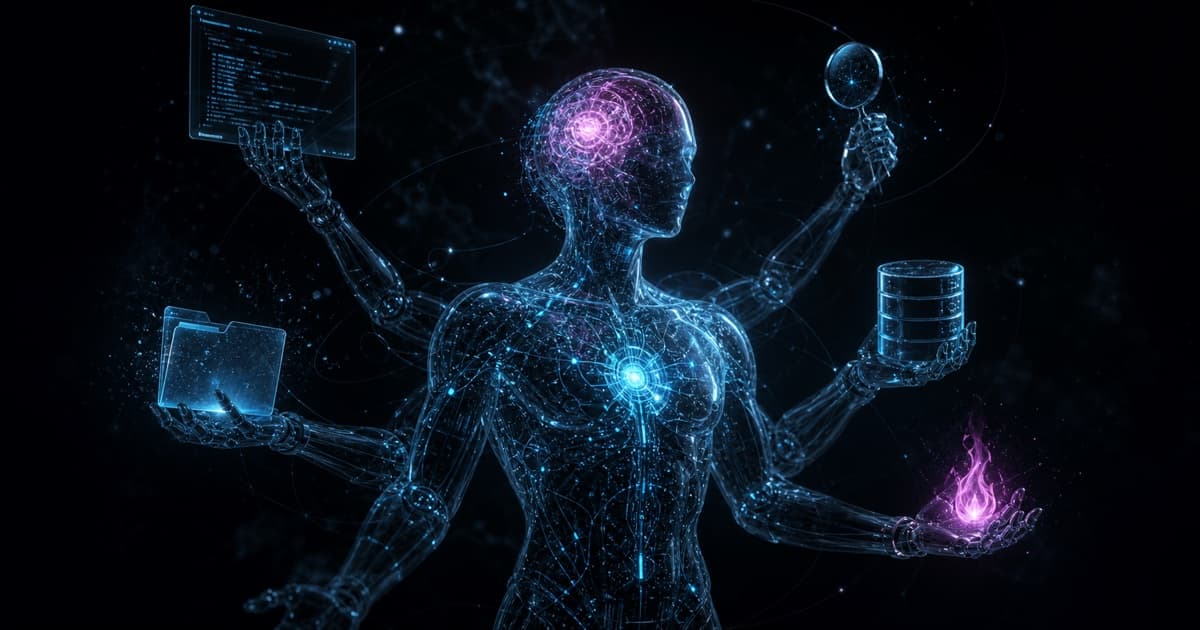
"Agent" became the "blockchain" of 2026.
Every startup has one. Every SaaS shipped theirs. Every chatbot with two tools is now an "AI agent". And when you ask what an agent actually is, nobody agrees.
Before falling further into that definitional vacuum, it's worth pausing and answering honestly:
What is an agent, actually?
This article is a pragmatic synthesis of the three best pieces I know on the topic:
The three arrive, through different paths, at very similar conclusions. That convergence is what makes the definition trustworthy.
The minimum definition
Chip Huyen brings back the classic Russell & Norvig definition:
"Anything that can be viewed as perceiving its environment through sensors and acting upon that environment through actuators."
In plain English: an agent perceives an environment and acts on it.
That's the floor. Without perception, it's just a script. Without action, it's just a classifier. Without an environment, it's just a one-shot chat.
When you replace "sensors" with "text input, tools, and file reads" and "actuators" with "tool calls that touch real systems", you get the modern version: an LLM with eyes and hands.
An agent is not the model
This is the most common mistake.
The model (GPT-5, Claude Opus 4.7, Gemini) is just the brain. On its own, it answers text and stops.
An agent is:
agent = model + environment + tools + decision loop (+ memory)
Cedric Chee calls this the "augmented LLM": the base model plus retrieval, tools, and memory. It's the foundational brick — and Anthropic frames it as the core building block of any serious agentic system.
Agent vs. workflow (Anthropic's distinction)
This is the part that clears most of the confusion.
Anthropic separates two worlds:
- Workflow: LLMs and tools are orchestrated through predefined code paths.
- Agent: the LLM dynamically decides the next step and how to use the tools.
Translation:
- If your code decides "now call tool X, then Y, then return", it's a workflow.
- If the model decides the next step, observing the previous result and replanning, it's an agent.
That's why "agent" is a spectrum, not a switch. You can have:
- Plain LLM — one response, no tools.
- Augmented LLM — tools, retrieval, memory, but a fixed sequence.
- Workflows — multiple LLMs orchestrated by code (chaining, routing, parallelization, orchestrator-workers, evaluator-optimizer).
- Agents — the model controls its own loop.
Anthropic lists five workflow patterns that cover most production cases:
- Prompt chaining — output of one becomes input to the next.
- Routing — classify the input and dispatch to a specialized handler.
- Parallelization — concurrent tasks (sectioning or voting).
- Orchestrator-workers — a central LLM delegates to workers.
- Evaluator-optimizer — one LLM evaluates and refines another's output.
Most of what's in production today is workflow, not agent. And that's fine — workflows are more predictable and cheaper.
The DNA: four pieces that show up in every definition
Cross-referencing Huyen, Anthropic, and Chee, four components always come up:
1. Environment. What the agent can observe and modify. A coding agent lives in filesystem + terminal + Git. A support agent lives in CRM + knowledge base. No environment, no agency.
2. Tools. The hands. Huyen sorts them into three families:
- Knowledge augmentation: retrievers, APIs, web search.
- Capability extension: calculators, code interpreters, translators.
- Write actions: updating a database, sending email, executing a payment.
The last family is the scary one — and the one that multiplies value the most.
3. Planning. Decompose the task into steps, validate, execute, reflect, correct. Cedric Chee makes the case for explicit role separation: Planner, Evaluator, Executor. Only validated plans get executed.
4. Memory. Whatever survives across steps and sessions. Short-term (context), mid (scratchpad, working memory), and long-term (vector store, files, database). Without memory, every step restarts from scratch.
Why errors compound (the math everyone ignores)
Huyen drops a brutal number:
A model with 95% per-step accuracy collapses to ~60% over 10 steps.
0.95^10 ≈ 0.598
That's why "just plug in one more tool" rarely fixes anything. Long agent runs compound errors exponentially. The three known defenses are:
- Short loops — fewer steps, less cascade risk.
- Verification — check output before continuing (evaluators, types, tests, lints, human-in-the-loop).
- Idempotency and undo — cheap undo beats getting it right the first time.
This connects to another piece I wrote on Agent Harness Engineering in practice: the harness — environment, rules, tools, verification loops — usually matters more than the model itself.
When to use an agent, when to use a workflow
Anthropic's rule is uncomfortably simple:
Start simple. Only add complexity when the measured gain justifies it.
Translation:
- Workflow for well-defined tasks, predictable steps, high volume, low cost of compounded error.
- Agent for open-ended problems where steps cannot be pre-decided, and where flexibility justifies the extra cost and risk.
In practice:
- "Extract fields from a PDF and write to DB" → workflow.
- "Resolve this random support ticket spanning four systems" → maybe agent.
- "Refactor this repo following this convention" → agent, with a strong harness.
Almost nobody needs an agent where a workflow does the job. And almost everyone is paying agent costs to solve workflow problems.
The convergence
The most interesting point in Cedric Chee's piece is meta: he shows that Anthropic and Huyen, coming from different places, land on the same building blocks — augmented LLM, tools, memory, planning, evaluation loops. This is no longer "lab X's theory" — it's established practice.
Which means, practically:
- If you're designing an agentic system today, you can stop inventing vocabulary and adopt what already converged.
- The trade-offs are the same: autonomy × predictability, flexibility × cost, openness × safety.
- The question is not "should I use an agent?" but "where on the autonomy spectrum does this problem live?"
In one sentence
An agent is an LLM that perceives an environment, dynamically decides its next step, acts through tools, and closes the loop with memory and verification.
Anything below that is a workflow. Anything above that doesn't really exist yet.
Next time someone tells you they have an "agent", ask three things:
- Who decides the next step — your code or the model?
- What tools does it have, and what do they write to the real world?
- How does the system verify a step succeeded before continuing?
If the answers are vague, it's probably a chatbot with better marketing.
Source reading:
- Chip Huyen — Agents
- Anthropic — Building effective agents
- Cedric Chee — The DNA of AI Agents
Written by AI, reviewed by Thiago Marinho
May 22, 2026 · Brazil